my 2026 spring reading bucket list
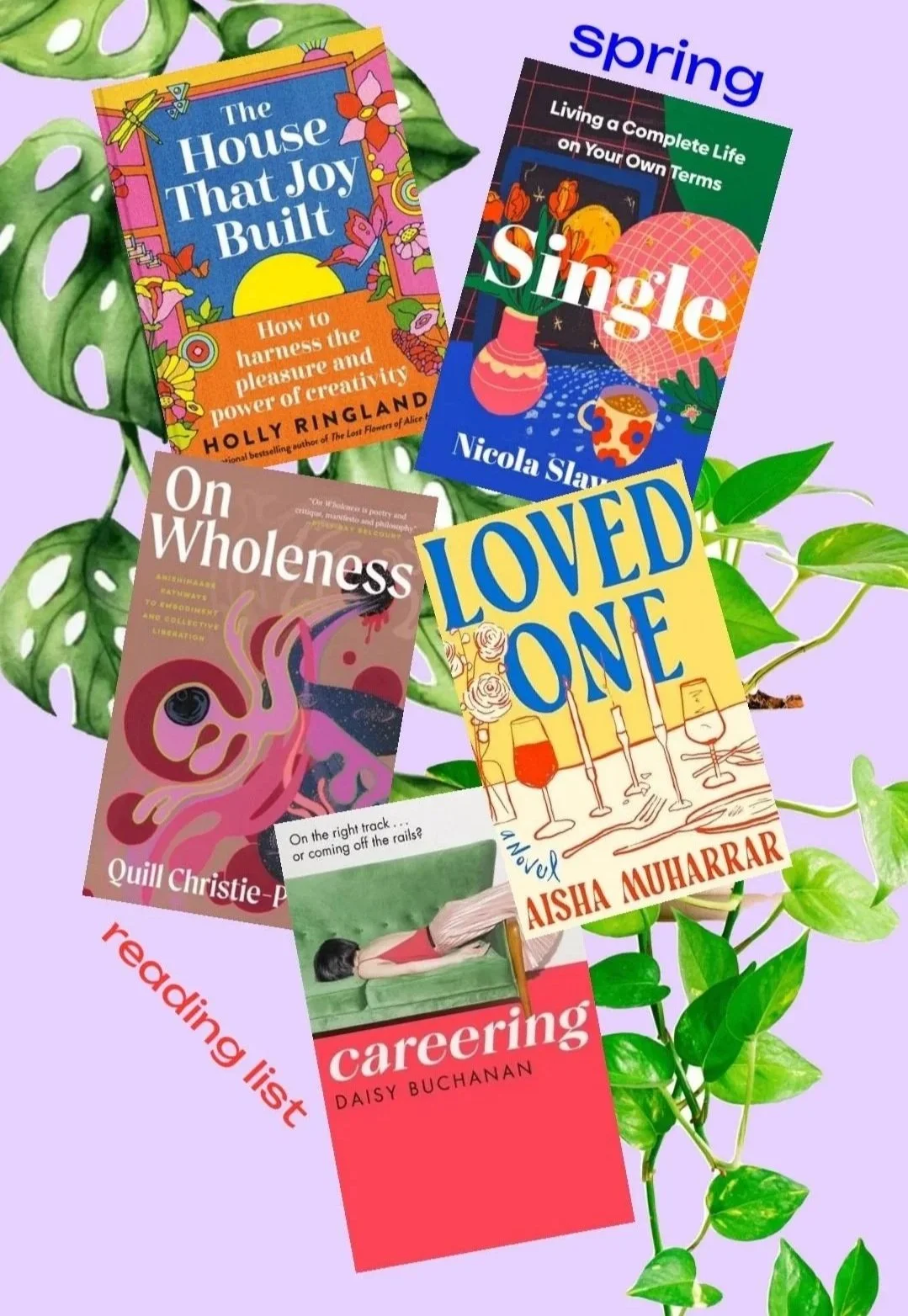
It is almost spring and I am excited to read in the park, in my home with the windows open, by a body of water, or wherever else I feel like reading as the season changes. My reading list is usually pretty reflective of the kind of mindset I am in at any given season—what ideas I want to explore, what themes are spinning around in my head, etc. I have a running reading list on Pinterest but these are some of the more recent ones that have caught my attention that I can’t wait to read/listen to this spring.
The House That Joy Built: How to Harness the Pleasure and Joy of Creativity by Holly Ringland
Goodreads synopsis: “The House That Joy Built is about how to give ourselves permission to be creative. It explores all the big fears that can block our creativity, and the permission we can meet those fears with – not simply to create, but to revel in the life-changing wonder and joy of doing so.
It offers a jump-start for anyone whose desire to create is ruled by fear. For those who yearn to write, or find creativity in other ways – gardeners, sculptors, florists, songwriters, dancers, cooks, painters – anyone who wants to make something but doesn't because they're afraid. Afraid of feeling vulnerable, of criticism and judgement from others, of not being good enough, of not having enough, of having 'bad ideas', of being 'too much'.
In lyrical, inspirational prose, Holly Ringland examines her own sometimes difficult journey to a successful writing career and offers a wealth of encouragement for anyone who wants to unlock their imagination. This audiobook is an empowering clarion call to overcome doubt and experience the joy and freedom of creating.”
This book speaks to me right now because I have been finding so much joy and empowerment in creating lately, but for so long I was embarassed to create, and sometimes still am. I find the practice of creating very liberating, especially when not used solely for monetary purposes, because it’s a such a grounding, human thing to do. I want to create more this spring so this seems like a good place to start.
Single: Living a Complete Life on Your Own Terms by Nicola Slawson
Goodreads synopsis: “In Living a Complete Life on Your Own Terms, leading journalist and advocate for singles Nicola Slawson shares her insights and experience from a decade of single life. Taking an open and honest look at the challenges of singledom, but just as keenly celebrating its joys and opportunities, the book will bring companionship, insight, succour and inspiration to its readers.
Around 40 per cent of UK adults are single at any one time. Far from being a transitional state between relationships, singledom can offer freedom, self-discovery and self-determination. At the same time, there are challenges, from social to economic. How do you handle cancer treatment if you are alone? Who do you call if you're stranded out late at night? If you don't find the right person to have a baby with, should you become a parent alone?
Nicola explores being single in a world designed for couples, and how to make the most of life in the face of stigma and misunderstanding. If you are newly single, long-term single, avowedly single, reluctantly so, considering leaving your current relationship or just wondering what to say to your aunt when she asks if you'll ever get married - this book is for you.
Chapters cover all aspects of single life, from dating apps to navigating friendships when it feels like everyone is coupling up except you, and from parenting after divorce to the rise of incels in society. Along the way, Nicola interviews the key single voices of her generation, as well as the lives of iconic singles of the past. With thorough research, lived experience and wry humour, this book is an essential guide to living a complete life on your own terms.”
My interest in this book is pretty self-explanatory—I’m single. I am not someone who intends to be single forever or is attached to the idea of being single, but I’m also not attached to the idea of being coupled. Something my twenties have taught me so far is that you have to be able to have a complete and fulfilling life by yourself, for yourself. For that reason, I’m really trying to lean into this era of singledom and learn more about myself, what makes me happy, what I want for my life, etc. This book essentially seems like meditations on the single condition in this day and age, which I think will really help guide me on my journey of embracing singledom and finding fulfillment in myself.
On Wholeness: Anishinaabe Pathways to Embodiment and Collective Liberation by Quill Christie-Peters
Goodreads synopsis: “A brilliant exploration of the body as a site of settler colonial impact, centring embodied wholeness as the pathway to our collective liberation.
This fierce and enlightening book explores a new way of understanding settler colonialism through the intimate lens of how it impacts the body. We start in the place before birth, before time, and before form, swirling like smoke with our ancestors in the great beyond. But we are born into bodies that are contorted, eroded, and shaped by the settler colonial environment. In lyrical and vulnerable prose, Anishinaabeg visual artist Quill Christie-Peters shares her experiences of colonial disembodiment through gendered violence and her father’s legacy as a survivor of residential school.
Despite colonial violence, the Anishinaabeg perspective sees the body extending to encompass ancestors, homelands, spirit relations, and animal kin. Dancing with the wild smoke swirling within, Quill explores the themes of childbirth, parenting, creative practice, pleasure, and expansive responsibility to chart a pathway to wholeness. An integral part of Indigenous resurgence and resistance, wholeness is also the pathway to liberation for all people.”
I know very little about indigenous philosophy and perspectives. I love philosophy and minored in it in college, but sadly, I learned very little outside of the white European androcentric lens that introductory philosophy courses always tend to center. I am a theory girly and love sociology, philosophy, race and gender studies, and any of the intersections thereof. I think it is always valuable to learn from others whose philosophies and perspectives you know little about. This is one of those books—I know nothing about the Anishinaabe people (the indigenous people of the Great Lakes region). I even had to look up who they were when I found this book. I see this as a great learning opportunity and a way for me to continue the lifelong work of educating oneself about systems of oppression. I have also been very interested in the ways systems of oppression affect the physical body, so the synopsis really drew me in.
Loved One by Aisha Muharrar
Goodreads synopsis: “When Julia’s first-love-turned-best-friend Gabe, a musician with a cultish following, dies unexpectedly at age twenty-nine, Julia launches herself into an intercontinental quest to recover the possessions he left with friends and acquaintances across the world. Along the way she encounters Elizabeth, Gabe’s effortlessly perfect and endlessly cool ex-girlfriend. Now Julia can’t stop talking to, thinking about, and googling Elizabeth. As the two women struggle to reconcile their respective claims on Gabe’s memory, can they find their way from rivalry to friendship?”
I already know I’m gonna cry! I love fiction, and I especially love fiction that deals with themes like grief, love, loss, memory, and complex relationships—particularly between women. I also was drawn in by the “intercontinental quest” bit—I love a good quest.
Careering by Daisy Buchanan
Goodreads synopsis: “Imogen has always dreamed of writing for a magazine. Infinite internships later, she dreams of any job. Writing her blog around double shifts at the pub is neither fulfilling her creatively nor paying the bills.
Harri might just be Imogen's fairy godmother. She's moving from the glossy pages of Panache magazine to launch a fierce feminist site, The Know. And she thinks Imogen's most outrageous sexual content will help generate the clicks she needs. But Imogen's fairy-tale ending soon sours as she finds herself putting more and more of herself into writing for a company that doesn't care if she sinks or swims.
Neither woman is aware of the crucial thing they have in common. Harri, at the other end of her career, has also been bitten and betrayed by the industry she has given herself to. Will she wake up to the way she's being exploited before her protégé realizes that not everything is copy? Can either woman reconcile their love for work with the fact that work will never love them back?”
More women-centered fiction! I have been thinking a lot about my relationship to work lately and on a larger scale, women’s relationships to work in overall. I also was once an aspiring writer and gave that dream up to have more stability in my life, so I think when I first read the synopsis I thought ‘This could have been me.’ But also, it is me, and it is you, because we live in capitalism and have to grapple with the difficulties that come with working in a system that, frankly, doesn’t care about us. We are all exploited under capitalism, but I find the way that women, especially female creatives, are exploited to be extremely sneaky and evil. These are just the things on my mind as I type in March 2026 and have just paid my taxes and worked a 68 hour work week! Ahhhh.
That is my reading list for spring 2026. If I get around to all of them as I plan to, I’ll do a part 2 with a review of all five books. Happy almost-spring solstice!